
Hidden Britain
The Stone Circles They Left Behind
British history has a habit of beginning late. Ask somebody to picture the past, and the Romans usually arrive fairly quickly. After them come Saxons, Vikings, castles, kings, monasteries, knights and the reassuring sequence of people whose names can be attached to dates. The Romans are particularly useful because they wrote things down. They left roads, forts, inscriptions, coins and enough administrative evidence for historians to begin constructing something recognisably like a story.
The people who were here before them are more difficult. They left houses, burials, tools, pottery, weapons, animal remains, field systems and the accumulated rubbish from which archaeology has reconstructed an extraordinary amount of human life. Yet the standing stone has become perhaps their most persistent presence in the British landscape. Stones survive in fields, on moorland, beside roads and among sheep, monuments built by people whose names, languages and explanations have disappeared.
Stonehenge became famous enough to escape this obscurity. It has a visitor centre, buses, barriers, guidebooks and the slightly peculiar experience of standing beside an A-road while contemplating the Neolithic. It is one of the most recognisable prehistoric monuments on Earth. The mistake is assuming it was alone. Britain and Ireland contain hundreds of stone circles alongside standing stones, henges, chambered tombs and other prehistoric monuments. Some are spectacular. Others consist of stones modest enough that an inattentive walker could pass them without realising somebody deliberately placed them there four or five thousand years ago.
That is the hidden Britain I find more interesting: not hidden because somebody concealed it, but because we stopped looking.
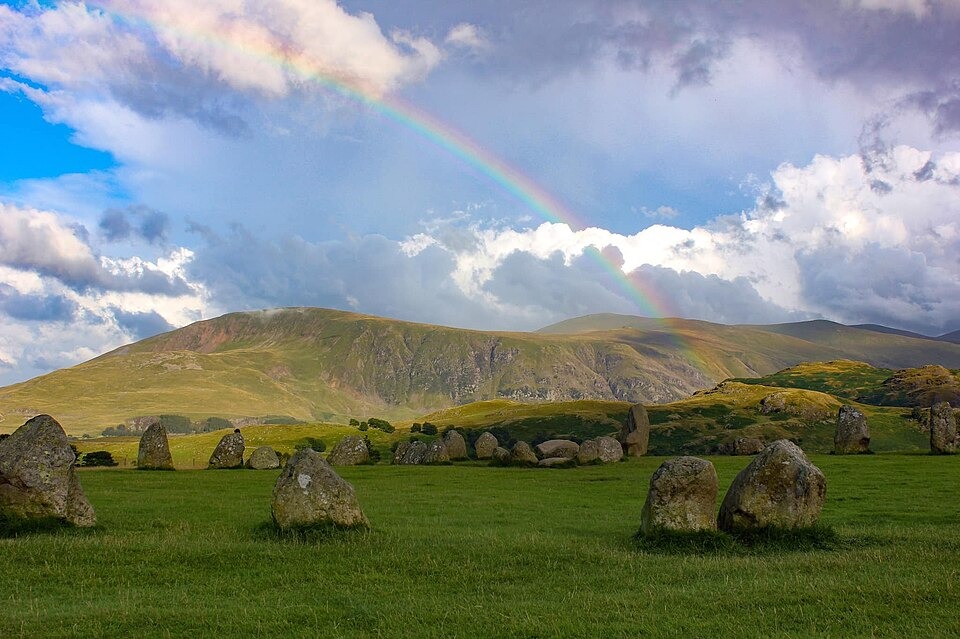
At Castlerigg near Keswick, thirty-eight surviving stones stand in a circle surrounded by the Lake District fells. English Heritage dates the monument to around 4,500 years ago, in the late Neolithic, although the absence of modern excavation means its precise age remains uncertain. The largest stone may weigh around sixteen tonnes. Whatever the circle meant, moving and erecting stones on that scale required organised communal effort.
Castlerigg almost invites you to make things up. You stand in the middle of it with the fells around you, and before long you're looking from a stone to a summit and wondering whether somebody meant that. The gaps start looking important too. Maybe some of them were. The builders may have watched the solstice here, or gathered at particular times of year, and there is archaeological evidence behind some interpretations of stone circles. The trouble begins when a possibility quietly becomes an explanation. We don't like gaps in a story, particularly one this old. Where written evidence disappears, imagination rushes into the vacancy carrying druids.
The Victorians were particularly enthusiastic about this. Stone circles accumulated folklore, astronomical theories, supposed sacrificial practices and romantic associations. Castlerigg itself was altered during the eighteenth and nineteenth centuries: stones were moved or re-erected and larch trees planted within the circle to create something resembling a suitably mysterious “druidical grove”. Four thousand years of genuine mystery apparently weren't atmospheric enough.
The habit survives in more commercial forms. Search for prehistoric monuments online and archaeology quickly finds itself sharing a room with ley lines, lost civilisations, healing energies and theories involving technologies considerably more advanced than anything found in the archaeological record. Mystery becomes an invitation to supply whatever explanation we find most satisfying. The real mystery is better. Archaeology can establish plenty about these places without pretending it can tell us everything.
Stonehenge demonstrates the distinction. It was not a settlement and was not designed for defence, while its construction required enormous organised effort. The monument and surrounding landscape contain evidence associated with burial and ceremony, and its relationship with movements of the sun is unmistakable. Archaeology can tell us when different phases were constructed, where some of the stone originated and how the surrounding landscape was used. What it cannot give us is the explanation of the people who built it. They left no minutes explaining that the north-eastern entrance had been approved after extensive consultation with local residents.
Archaeology instead reconstructs behaviour from matter. Where did the stone come from? When was the ditch dug? What was buried nearby? Was the monument altered? Which direction does an entrance face? What was happening elsewhere in the landscape at the same time? Increasingly, the answers suggest these monuments should not be understood as isolated circles at all, but as parts of complicated landscapes.
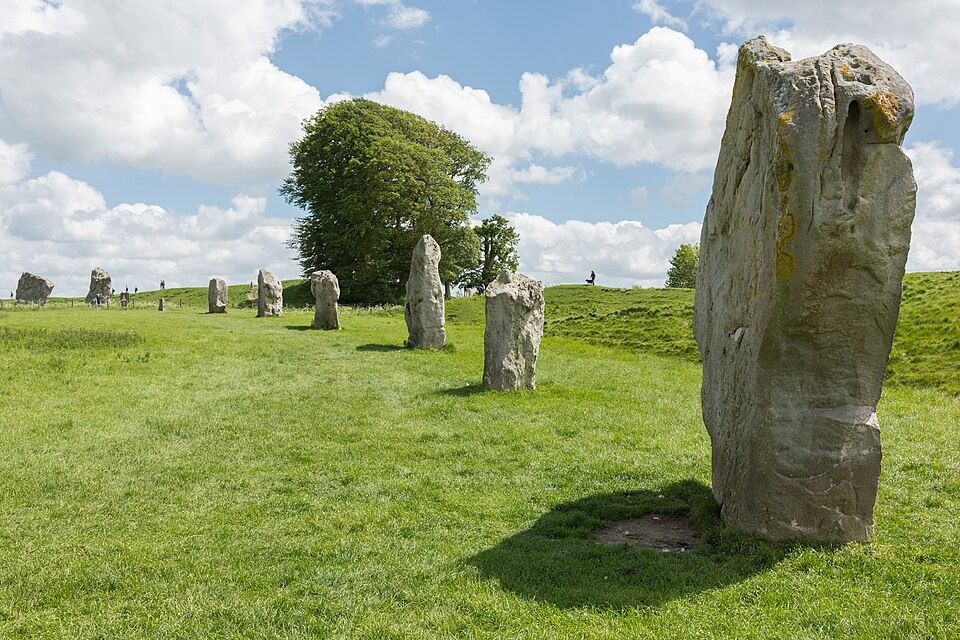
Avebury makes this obvious. Its enormous henge and stone circles form only part of a wider prehistoric complex in Wiltshire that includes West Kennet Avenue, Silbury Hill, West Kennet Long Barrow, the Sanctuary and other monuments. The main henge dates to roughly 4,600 years ago. Its great ditch was excavated from chalk using tools of stone, wood and bone, with the material piled into banks that would have appeared strikingly white when newly constructed.
The scale of the labour is worth considering. There were no excavators, tipper trucks or diesel engines complaining somewhere nearby. Human beings with comparatively simple tools moved extraordinary quantities of earth because whatever this place meant to them justified the effort. That tells us something even when the belief itself is lost. These were organised communities capable of planning substantial projects, mobilising labour and sustaining purposes extending beyond immediate survival.
The familiar cartoon of prehistoric people wandering around hitting one another with clubs becomes difficult to maintain when confronted with monumental engineering. They farmed, traded and travelled. They understood materials and landscapes, buried their dead according to practices that changed over time, gathered in considerable numbers and built things intended to endure. The stones are not evidence of primitive people. They are evidence of people from whom most of the evidence has disappeared.
Writing gives later societies an extraordinary historical advantage. Once people record laws, transactions, names, victories, complaints, prayers and shopping lists, historians can begin hearing individual voices. Ancient graffiti can preserve a joke. A letter can preserve an argument between people dead for centuries. An inscription gives somebody a name.
Prehistoric Britain denies us that intimacy. We can find a body and estimate age, diet, disease and injury. Isotope analysis can sometimes reveal that somebody travelled considerable distances during their lifetime. We can reconstruct houses, examine tools and discover what people ate. Yet we cannot ask what they called themselves, what stories they told their children or what the person responsible for positioning a particular stone thought they were doing. The archaeological record can bring us astonishingly close to people while leaving the person themselves permanently out of reach.
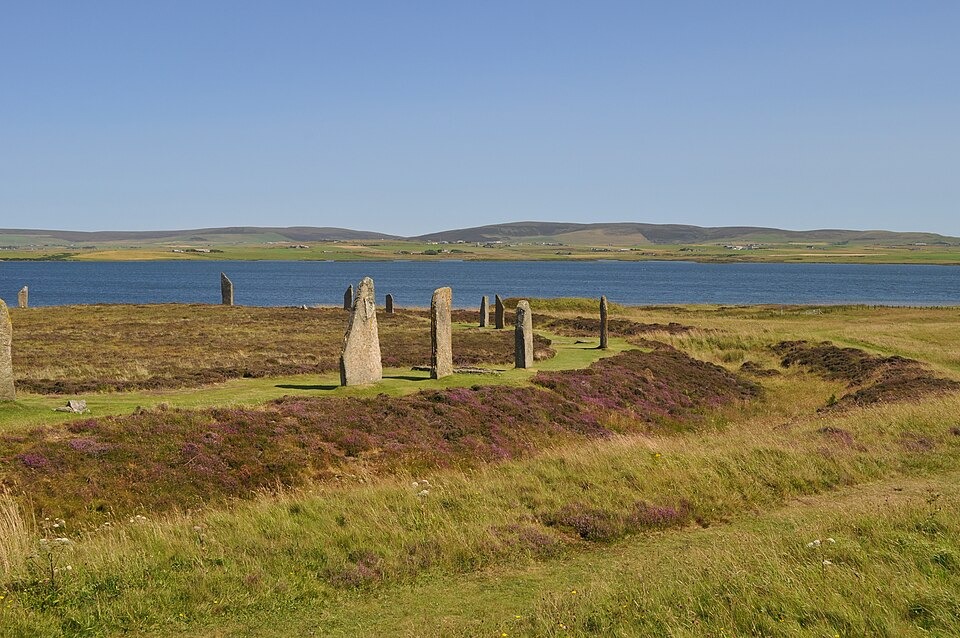
Orkney shows how much can survive even when those individual voices do not. On Mainland Orkney, the Ring of Brodgar and the Stones of Stenness sit within one of the richest surviving Neolithic landscapes in Europe. The Ring of Brodgar was probably constructed during the third millennium BC. It originally contained around sixty stones; thirty-six survive. Nearby, four enormous uprights remain at the Stones of Stenness from an original circle of twelve.
What matters here is not simply the survival of two impressive circles. Tombs, settlements and other monuments occupy the same wider landscape. Places that can appear individually mysterious look rather different when understood as parts of a world in which people lived, travelled, gathered and buried their dead. The meaning of any particular stone may remain elusive, but the landscape makes isolation increasingly difficult to believe.
Perhaps uncertainty should not disappoint us. It may be one of the most important things these monuments can teach. Modern life, after all, is surrounded by explanation. Buildings have planning records. Objects have instruction manuals. Events are photographed from six angles and uploaded before they have finished occurring. If somebody erected a sixty-stone circle today, there would be a website, consultation documents, a funding announcement, several angry Facebook groups and somebody demanding to know where everybody was supposed to park.
We can see that these monuments mattered because of the effort people put into building them, even if much of the reason for doing so has disappeared. That becomes more noticeable at the smaller sites, where there is less interpretation waiting for you when you arrive. Torhouse is one of them.
Torhouse, near Wigtown in Dumfries and Galloway, consists of nineteen granite boulders forming a circle about twenty metres across, with three stones standing in a line at its centre. By the seventeenth century those central stones had acquired an association with “King Gauldus”, but whatever meaning the original builders gave them had long since disappeared. It is considerably harder to turn Torhouse into an icon, and that may be why places like it matter.
There is no requirement for every encounter with history to involve something world-famous. Concentrating only on famous monuments can distort our understanding of the past in much the same way that concentrating only on kings distorts history. A stone circle was not prehistoric Britain's equivalent of a tourist attraction sitting conveniently beside a road. It existed among paths, settlements, fields, water, burial places and other monuments. People approached it through a landscape they understood intimately. Hills and rivers may have carried meanings we can no longer recover. What now looks isolated may not have felt isolated at all.
The landscapes around these monuments have changed enormously. Some stones disappeared when land was farmed or built on; elsewhere peat covered what survived. Roads, fields and settlements changed how the remaining sites were approached and understood. Archaeology can complicate the picture further, because occasionally a monument turns out not to be what earlier researchers thought it was.
Steinacleit on Lewis is a good example. It emerged from beneath the peat during the twentieth century and was first interpreted as a stone circle and chambered cairn. Comparisons with excavated sites elsewhere have since raised doubts about that description, with an early farmstead now another possibility. Nobody has fully excavated Steinacleit, so there is no tidy answer yet. Nor should there have to be. Archaeology changes its mind when the evidence gives it a reason to.
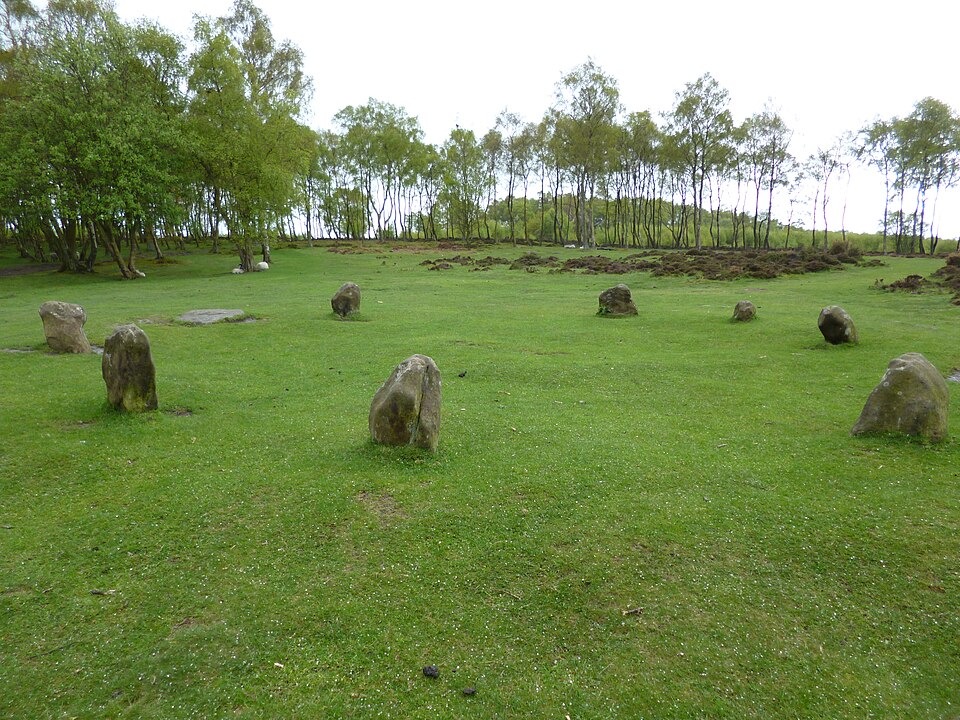
We often want history to provide certainty because we mistake uncertainty for ignorance. In reality, saying we do not know can be the product of considerably more scholarship than confidently repeating an attractive story. Stone circles have suffered particularly badly from attractive stories. Folklore repeatedly transforms them into petrified people: dancers punished for breaking the Sabbath, wedding parties, kings, witches and other unfortunate groups who apparently encountered an unusually enthusiastic geological justice system. At the Nine Ladies stone circle in Derbyshire, for example, the traditional story holds that nine women were turned to stone for dancing on the Sabbath, with the nearby King Stone representing the fiddler.
The folklore is not archaeology, but it is history.
It tells us little reliably about the people who built the circle, but something about those who encountered it centuries later. They saw ancient stones whose builders had disappeared and invented an explanation. In doing so, they became another layer of the monument. Prehistoric sites should not therefore be treated merely as puzzles waiting for archaeology to solve. Their histories continued after their original purposes disappeared.
The stones remained after their original purpose had been forgotten. People living near them found their own uses and explanations for them. Some were moved or taken away, while others attracted the attention of antiquarians and, later, archaeologists. Folklore accumulated around them and visitors eventually came to see them. By then, thousands of years separated those encounters from the people who had first put the stones in place.
Britain markets its history extremely well when the history has battlements. Castles are straightforward. They offer battles, sieges, kings, ghosts and somewhere to buy a wooden sword on the way out. Stately homes provide paintings, scandal and tea. Industrial museums provide machines that occasionally still move. Prehistory asks more of the visitor.
You may arrive and find twelve stones in a wet field with several sheep displaying considerably less interest in them than you are. Nothing happens. That can be the entire experience unless somebody has learned how to look; once you understand that those stones were deliberately selected, moved and positioned thousands of years before the Roman conquest, the field changes. Somebody stood where you are standing when the landscape itself looked different. People gathered there for reasons important enough to justify communal labour, and generations may have returned to the same place.
The stones are not remarkable simply because they are large. They are remarkable because they stayed.
This is where prehistoric Britain connects to the wider question of heritage. We naturally preserve monuments when we understand their significance. Prehistory asks whether something can deserve protection precisely because we do not fully understand it. Destroy an unexcavated prehistoric site and information disappears that nobody had yet learned how to read. Archaeological techniques improve, scientific methods change, and new questions allow researchers to extract information from material earlier generations could not have imagined using. Soil beneath a monument may therefore contain evidence more valuable to future archaeologists than anything we could recover from it today.
There are times when the best decision is simply to leave a site alone. Archaeologists in fifty years may have techniques or questions that do not exist today, and an excavation cannot be undone once it has taken place. The same is true of the monument itself.
Damage can be repaired and missing stones can be copied. What cannot be recreated is the place where people gathered five thousand years ago.
The builders are gone, their languages are gone, and much of what they believed may be unrecoverable. What remains is matter arranged by intention.
Perhaps British history should begin there more often. Not because the Neolithic provides a convenient national origin story—it does not. Britain itself, its population, languages, borders and political identities changed repeatedly afterwards. We should be particularly wary of recruiting prehistoric people into modern ideas of nationality they could not possibly have recognised.
They matter not because they were “British” in our modern sense, but because they were here. They walked landscapes beneath our roads and towns. They quarried stone, raised animals, grew food, travelled, buried their dead and built monuments whose physical presence has outlasted almost everything that explained them.
The Romans eventually arrived and gave historians considerably more to work with. Later centuries produced chronicles, charters, parish registers, newspapers, photographs and finally the modern catastrophe of everybody documenting lunch. The stones belong to an earlier kind of memory. They cannot tell us precisely what happened, but they tell us that something did.
Scattered across Britain, in fields and moorland and landscapes we think we already know, they are still waiting for us to notice.

Post a comment