
Why Art and Philosophy Need to Be Pushed?
Learning to Look, Learning to Ask, and an Education Larger Than Employment
We have developed a peculiar habit of asking young people what they intend to do with everything. Choose art, and somebody wants to know whether you intend to become an artist. Mention philosophy and the question becomes even more suspicious, usually followed by an enquiry about what sort of job a philosopher actually gets. Mathematics is permitted to exist because mathematics is obviously useful. Computing has an industry waiting for it, engineering produces things we can point at, and science can usually produce a laboratory before anybody becomes difficult. Art and philosophy are left standing at the careers fair attempting to explain themselves.
This is not entirely unreasonable. Education takes years, costs money and occupies a substantial part of childhood. Young people deserve qualifications that help them build independent lives, and there is nothing noble about leaving school intellectually enriched but incapable of earning enough to pay the electricity bill. Employment matters. Practical skills matter. Science, mathematics, engineering and technology matter enormously, particularly in a country that periodically discovers it has a shortage of people capable of actually making and repairing things. The mistake is assuming that because education must prepare somebody for work, work must therefore explain the whole purpose of education.
Art and philosophy make that assumption particularly interesting because their benefits refuse to remain within a job description. Art can teach somebody to look more carefully; philosophy can teach somebody to ask why. Neither sounds particularly revolutionary until we consider how much of adult life depends upon observation and questioning.
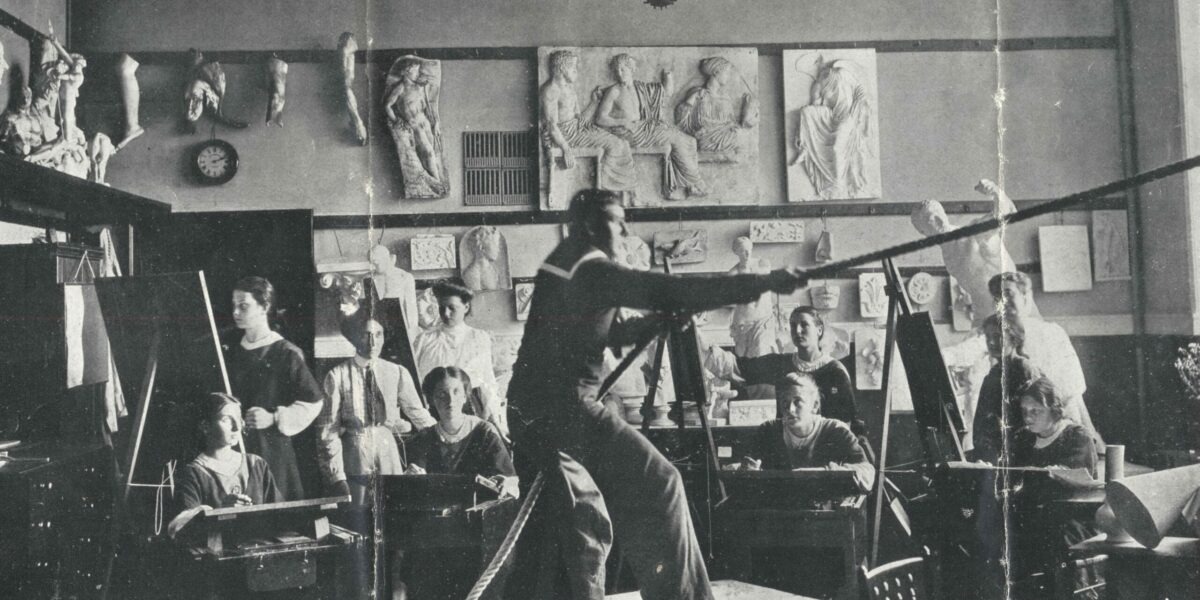
Looking is not the same thing as seeing. Give somebody a pencil and ask them to draw the chair in front of them and they quickly discover how little attention they have previously paid to chairs. The legs are not where they assumed they were, the angles are wrong, perspective behaves strangely, and an object used every day suddenly becomes complicated. Drawing begins with the mildly humiliating discovery that the world does not necessarily look the way we remember it looking.
That lesson reaches considerably further than making pictures. An art student learns to observe proportion, light, negative space, texture, structure and relationships between objects. Changing where they stand changes what they see. They learn to look at the whole and then the detail, to make something, recognise why it has failed and make it again. None of this requires the student eventually to become an artist. The habit of observation remains useful long after the sketchbook has been put away.
We sometimes make art education sound as though its principal purpose is producing more artists. That is rather like arguing that the purpose of school football is to supply the Premier League. Most children who play football will never become professional footballers, and nobody considers the exercise wasted. They may develop coordination, fitness, teamwork, confidence and, ideally, the ability to lose without accusing the referee of participating in an international conspiracy. Art deserves some of the same generosity.
Studying art does not mean somebody has to make a career from it. They might end up working in architecture, design or film, but they might just as easily become a surgeon, teacher or electrician who still likes to draw. They may visit galleries, notice why one building feels pleasant to enter while another resembles somewhere designed to process tax returns, or simply pay more attention to things other people walk past. And every office needs at least one person prepared to explain that putting twelve fonts on the same poster is an act of violence.
Art also gives young people experience of something we are not always very comfortable with: making something badly. The first drawing is often terrible. The first painting does not resemble the thing it was supposed to resemble, the clay collapses, the photograph is badly composed, and the carefully constructed object refuses to stand upright. There is no button that makes the first attempt disappear before anybody notices. You have to look again, change it, scrape something off, paint over it, start another sheet or accept that three hours of work have produced something with approximately the aesthetic appeal of a damp cardboard box.
Then you try again. You work out why the drawing looks wrong, change something and discover that the next attempt is a little better. Do that often enough and getting things wrong stops being quite so remarkable. It is simply part of making something, although finished work has a habit of hiding how many unsuccessful attempts came before it. Even published novels spare us the drafts that deserved humane destruction.
Philosophy begins from a different direction and arrives somewhere surprisingly similar. Instead of asking somebody to look again, it asks them to think again. Why do you believe that? It is an extraordinarily irritating question.
Most of us carry around a collection of beliefs acquired from parents, schools, friends, newspapers, political traditions, religion, television, experience and people on the internet who appear unusually certain about things. Some of those beliefs are well-founded. Others may be assumptions we have never examined because nobody has asked us to. Philosophy does not necessarily tell us which ones to keep; it gives us methods for examining them.
That matters particularly for young people because we spend much of childhood giving them answers. Here is how multiplication works. Here is the capital of France. Here is the chemical symbol for gold. Here is what happened in 1066. Education necessarily contains facts because there are things worth knowing, and a person cannot think critically about a subject they know absolutely nothing about. Ignorance does not become intellectual independence merely because it has confidence.
Philosophy introduces a different sort of problem. What makes something right? What do we owe other people? Can an unjust law still demand obedience? What makes somebody the same person over time? Is an action good because of its consequences or the intention behind it? What is knowledge? What is beauty? What makes a life good? The teacher cannot simply turn to page 214 and reveal that Aristotle got seven out of ten.
This can be unsettling in an education system where assessment necessarily plays a large role. Students encounter plenty of questions for which there are expected answers and marks attached to them. Philosophy also gives them questions on which intelligent people have disagreed for thousands of years and asks them to defend the quality of their reasoning instead. That is part of its value.
The ability to construct an argument is not the same thing as possessing an opinion. Everybody possesses opinions. We generate them with astonishing efficiency and now possess technologies capable of distributing them before we have suffered the inconvenience of thinking them through. An argument requires more work. What is the claim? What evidence supports it? What assumptions sit underneath it? What would follow if it were true? What might somebody who disagrees say, and can you answer them without deciding they are evil, stupid or both?
These are not merely academic skills. They matter whenever somebody is trying to persuade us. A young person entering adult life encounters an extraordinary amount of persuasion. Governments want their vote, businesses want their money, employers want their labour, charities want their support and online platforms compete for their attention. Advertising can resemble entertainment, entertainment can carry political messages, political messages can become entertainment, and somebody is usually trying to sell a dietary supplement. Under those circumstances, asking why should I believe this? does not seem particularly impractical.
Philosophy can also encourage intellectual humility. Following an argument far enough occasionally produces the deeply inconvenient discovery that the other person has a point. This does not require adopting their position. It means recognising that disagreement can exist without stupidity and that our own arguments can possess weaknesses too.
There is value in learning this young. Political and media culture can reward certainty, while the person who says “I don't know” is rarely the most memorable participant in a television debate despite occasionally being the only one telling the truth. Online discussion also makes it remarkably easy to find people who already agree with us. Under those conditions, changing your mind can begin to look like weakness. Philosophy offers another possibility: changing your mind because the evidence or argument has changed can simply mean that thinking occurred.
Art can do something similar with taste. A student may dislike a painting and then find it more interesting once they know something about it. They may admire the skill involved in a building while still thinking it is horrible to stand beside. Other people will inevitably like things they do not, and learning why can be more interesting than deciding somebody must be wrong.
None of this requires an unnecessary war between the humanities and STEM. The stereotype of the practical scientist on one side and dreamy artist on the other has never been particularly useful. Engineering involves design. Architecture requires mathematics and aesthetics to remain on speaking terms. Medicine raises ethical questions that cannot be settled by biology alone. Technology can create possibilities before society has decided whether every possibility should be used.
Artificial intelligence has made this overlap particularly visible. Questions about authorship, responsibility, originality and convincing falsehoods have moved rapidly from academic discussion into classrooms, workplaces, government and technology companies. Should a machine imitate a dead person's voice or appearance? Who is responsible when an automated decision causes harm? Technical expertise can tell us a great deal about what a system can do. Deciding what we should permit it to do requires other kinds of judgement as well.
Art is equally entangled with technology. Every digital interface somebody uses has been designed. Every game, application, advertisement, film and website contains aesthetic decisions, whether good ones or decisions apparently made during an emergency. Modern life is saturated with images.
Visual literacy matters partly for that reason. We do not encounter images without choices having been made about them. Somebody decided what went into the frame, what was left outside it and, in many cases, how the finished image would be edited or presented. Those decisions can affect what we notice and how we understand what we are looking at. Making images gives students some experience of making those choices themselves, which is useful when so much of what they encounter every day is visual.
There is, however, another reason to push art and philosophy that has very little to do with employment, public life or technological ethics. Young people should be allowed to encounter things whose value does not depend upon turning them into economic units.
We have become remarkably enthusiastic about monetising hobbies. Draw well, and somebody suggests commissions. Bake good cakes, and perhaps you should start a business. Enjoy making videos, and there is a channel to build. Write something, and immediately the question becomes whether it can be published. There is nothing wrong with any of these ambitions, and making a living from something you love can be wonderful. The danger is allowing every pleasure to become unpaid preparation for another job.
Sometimes somebody should be allowed to paint a terrible landscape and keep it.
A young person should be able to play an instrument without planning an album, read Plato without intending to become an academic, make pottery without opening an online shop and write poems that nobody except three friends will ever see. Human beings made art long before anybody developed a viable business model for it. This freedom matters because adult life contains enough obligation already. Bills arrive with admirable consistency, work expands, and houses require maintenance. An interest that belongs entirely to the person practising it can become one of the small structures around which a life is built.
Education has an opportunity to introduce those possibilities before adulthood makes time for them harder to find. Access matters here. Children do not all arrive at school with the same opportunities to encounter galleries, books, music, materials or adults who have the time and knowledge to introduce them. School cannot eliminate those differences, but it can provide encounters that might otherwise depend upon circumstances outside a child's control. If access to art is reduced at school, families with the means and inclination to provide it elsewhere are better placed to compensate than those without them.
Something similar applies to philosophy. Some young people grow up around adults who encourage argument, explain why they believe things and tolerate questions. Others may have fewer opportunities for that kind of discussion. A classroom can provide a place where questioning an idea is not treated as a challenge to the authority of the person who presented it. That is worth having.
There is inevitably a question of curriculum time. Every argument for teaching something in schools eventually collides with the inconvenient fact that school days contain a finite number of hours. Financial education, computing and practical skills all have claims. So do languages, music, sport, citizenship and cooking, while mathematics, English and science have obvious demands of their own. We cannot solve the problem by declaring every worthwhile subject compulsory until children require a thirty-hour school day.
There is no easy answer to what should make room for them. Schools have limited hours, limited budgets and only so many teachers, so giving more space to one subject inevitably puts pressure somewhere else. Art and philosophy have to justify their place in that competition too. Their difficulty is that much of what they offer cannot be attached neatly to a particular job or salary, but that does not make it useless. Some of what we learn at school only shows its value much later.
Not every student is going to enjoy either subject, and there is no reason to pretend otherwise. Some will encounter philosophy and decide that Socrates would have been unbearable at dinner. Others will get through six weeks of charcoal drawing and be quite happy never to touch the stuff again. They have still had the chance to find out. School can introduce people to things without requiring them to fall in love with all of them.
What matters is having some opportunity for the encounter. Someone cannot discover that they love sculpture if they never touch clay, and they cannot discover an interest in philosophy if nobody presents them with a question whose answer is not printed beneath it. Ability also needs opportunity before it becomes visible. We speak of gifted young artists as though they arrive already carrying portfolios, but somebody has to give them materials, teaching and time before anybody knows what they might do with them.
When that encounter never happens, its absence is difficult to measure. There is no missing painting to mourn because it was never made and no career we can confidently say would otherwise have happened. The value might instead be somebody who continues drawing for pleasure, visits galleries as an adult or simply remembers enjoying an hour each week in which they made something. That is less dramatic, but it still counts.
Art and philosophy have something else in common: neither works particularly well in a hurry. Drawing forces you to spend time looking at something you might normally glance at and move past. Following an argument properly requires a similar sort of patience. Both become rather more difficult when half your attention is on your phone.
Attention itself is heavily competed for. Young people grow up surrounded by media, services and devices competing to keep them engaged. Against that background, spending an hour drawing a hand or discussing whether an action can be legal and still unjust may appear quaint. It is also an hour spent deliberately attending to one thing. Perhaps that is one of the things a broad education can protect: some ability to decide where your own attention goes.
A person should leave school knowing enough mathematics to understand numbers used to persuade them, enough science to understand something of the physical world, enough history to know the present has a past, enough language to express themselves and enough practical knowledge to function independently. They should also have had opportunities to encounter art and serious questioning. None of these subjects needs to defeat the others.
None of this needs to lead to a particular career. An engineer might make better decisions because they understand something about design, while an artist who understands technology has more tools available to them. Ethics matters when scientists and engineers have to decide whether something that can be done should be done. Learning how arguments work may even make somebody a slightly harder voter to fool. And if none of that happens, they might simply leave school with an interest that gives them something enjoyable to do on a Sunday afternoon.
Preparing young people for employment is obviously part of education, but they have a great deal of life to live outside work as well. They will make decisions, form relationships, vote, pursue interests and work out for themselves what matters. Somewhere in that education there should be room to practise looking closely at something and asking whether the first answer they were given is necessarily the right one. Art and philosophy happen to be rather good places to do both.
Young people will spend the rest of their lives surrounded by people eager to tell them what to see and what to think. Giving them some practice doing both for themselves does not seem particularly impractical.

Post a comment